
Congratulations to Xavi, who just published his first lead-author paper as ACS Nano (2025) 19, 18, 17728–17737: a major milestone and a fantastic piece of work!
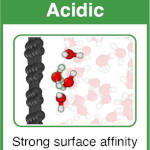
In this study, we tackled a long-standing question: how do protons and hydroxide ions behave at the graphene-water interface? While it’s well-known that protons like to hang out at the air-water interface, much less is understood at technologically relevant surfaces like graphene.
Using machine learning-based simulations with first-principles accuracy, we show that protons (hydronium ions) accumulate right at the graphene-water interface, whereas hydroxide ions display a split personality and are found both near the surface and deeper into the water layers. The local electronic structure reveals fascinating polarization effects, leading to unexpected charge rearrangements. This has big implications for how we interpret surface-sensitive experiments, and for processes like ion conductivity, interfacial reactivity, and proton-coupled reactions in nanomaterials.