
Clays are everywhere — from soil and contaminant transport to emerging energy technologies. But at the molecular level, the reactivity of their edge surfaces remains underexplored.
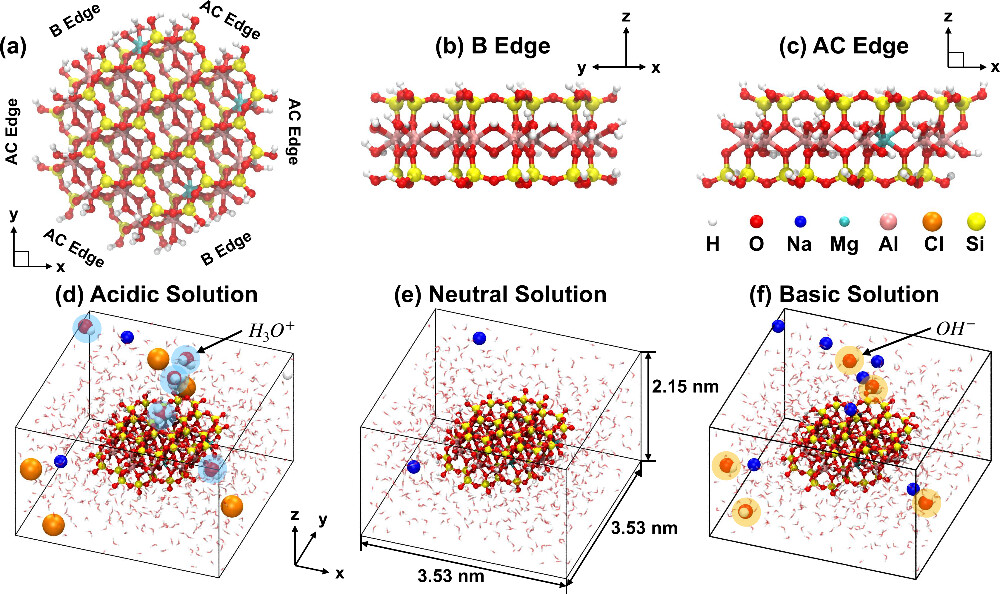
In this work, now published as J. Phys. Chem. Lett. (2026) 17, 9, 2679–2688, we show that clay edges are not static arrays of functional groups, but dynamic proton-conducting networks. Using machine-learned atomistic simulations, we uncover how protons move through edge sites via direct and water-assisted pathways, and how this behavior is tuned by structure and pH.
Our work provides a molecular-scale framework for interpreting charge buffering, conductivity, and sorption in geoscience; consequently, this opens opportunities to harness clays as proton-conducting materials in sustainable technologies (e.g. clay-based batteries). This further demonstrates the power of machine learning potentials to study systems that were previously hard to model.
Much kudos to Yixuan Feng, a brilliant group visitor from Tsinghua University, who led this work from start to finish!