
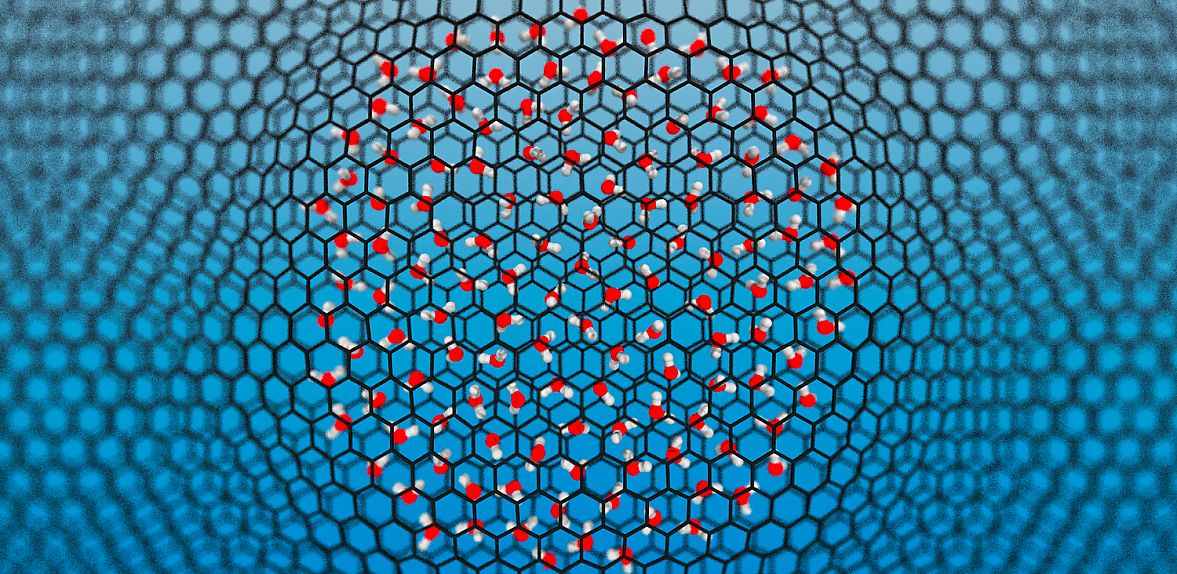
Does water become more or less reactive when squeezed into gaps just a few molecules wide? Literature has disagreed for years.
Using enhanced sampling molecular dynamics with machine-learned potentials, we found a surprisingly clean answer: confinement on its own doesn’t change water’s reactivity. Once you account for pressure and chemical potential, the apparent “confinement effect” largely vanishes. What does matter is pressure and the surrounding material, which together give a practical design principle for fuel cells, batteries, and nanofluidic devices.
Christoph & Xavi explain the work in this video: https://youtu.be/IZH4BDFDg3E
Congratulations to Xavi, who led this work from start to finish, now published as Sci. Adv. (2026) 12, eaeb5772! Also huge thanks to the whole team — Yair Litman, Kara Fong, Chuck Witt, and Angelos Michaelides — a collaboration across Cambridge, Harvard, Caltech, and MPI-P.