
Congratulations to Darren, who just published his first lead-author paper in Chemical Science! This marks our group’s second paper published within this month, following Terry’s achievement.
The contact angle that water makes on a solid determines how it wets the surface, but experimental measurements for the water-graphene contact angle span a wide range, with no consensus on graphene’s wettability.
Here, we use a machine learning potential to simulate water droplets on graphene at a first-principles level, finding graphene to be weakly hydrophilic under free-standing conditions. These simulations involved unprecedentedly large system sizes and simulation times — pushing the boundary of first-principles atomistic simulation — and required a new methodology to measure contact angles on non-flat surfaces.
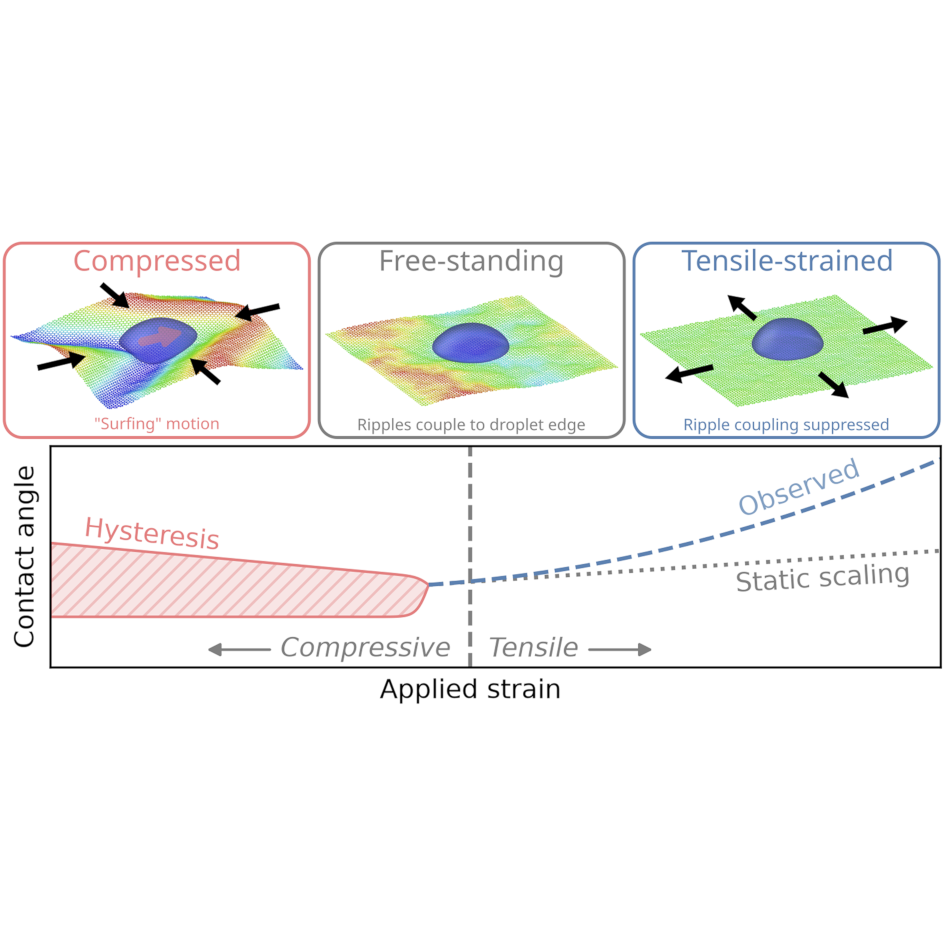
More importantly, we unveil that graphene’s wetting properties are highly sensitive to mechanical strain: tensile strain makes graphene significantly less hydrophilic, while compressive strain induces coherent ripples which the droplet “surfs”. We show that this strain sensitivity is caused by a coupling between graphene’s surface ripples and the wetting boundary, demonstrating that graphene’s wettability is governed not just by chemistry but also by its dynamic surface morphology.
This unexpected strain sensitivity may offer an explanation for noisy experimental measurements; on the flip side, it also reveals that mechanical strain may be a practical route to controlling wetting in 2D materials, with promising applications in nanofluidics and nanofiltration.