
2026
Darren Wayne Lim, Xavier R. Advincula, William C. Witt, Angelos Michaelides, Fabian L. Thiemann, Christoph Schran
Strain-dependent wetting of graphene Journal Article
In: Chem. Sci., 2026.
Abstract | Links | BibTeX | Tags: Machine Learning Potentials, Two-dimensional Materials, Water, Water at Interfaces
@article{Lim2026/10.1039/d6sc05377g,

title = {Strain-dependent wetting of graphene},

author = {Darren Wayne Lim and Xavier R. Advincula and William C. Witt and Angelos Michaelides and Fabian L. Thiemann and Christoph Schran},

url = {https://doi.org/10.1039/d6sc05377g},

doi = {10.1039/d6sc05377g},

year  = {2026},

date = {2026-10-20},

urldate = {2026-10-20},

journal = {Chem. Sci.},

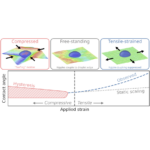
abstract = {Understanding how water wets graphene is critical for predicting and controlling its behaviour in nanofluidic, sensing, and energy applications. A key measure of wetting is the contact angle made by a liquid droplet against the surface, yet experimental measurements for graphene span a wide range, with no consensus for free-standing graphene. Here, we use a machine learning potential with ab initio accuracy to provide an atomistic first-principles prediction for this unsolved problem, finding a weakly hydrophilic contact angle of 72.1 ± 1.5°. More importantly, we unveil that graphene's wetting properties are highly sensitive to mechanical strain: tensile strain makes graphene significantly less hydrophilic, while compressive strain induces coherent ripples around the droplet, resulting in pronounced anisotropic wetting and contact angle hysteresis. We show that there is a strong coupling between the three-phase contact line and the intrinsic thermal ripples of free-standing graphene, which contributes to this strain sensitivity. Our results demonstrate that the wettability of 2D membranes is governed not only by their chemistry but also by their dynamic morphology, introducing a new class of wetting behaviour unique to atomically thin materials that offers an additional explanation for variability in experimental measurements. These findings reveal that mechanical strain may be a practical route to controlling wetting in 2D nanomaterials-based technologies, with promising consequences for nanofluidic and nano-filtration applications.},

keywords = {Machine Learning Potentials, Two-dimensional Materials, Water, Water at Interfaces},

pubstate = {published},

tppubtype = {article}

}

Xavier R. Advincula, Yair Litman, Kara D. Fong, William C. Witt, Christoph Schran, Angelos Michaelides
How reactive is water at the nanoscale and how to control it? Journal Article
In: Sci. Adv., vol. 12, iss. 26, pp. eaeb5772, 2026.
Abstract | Links | BibTeX | Tags: Chemical Reactivity, Confinement, Machine Learning Potentials, Two-dimensional Materials, Water, Water at Interfaces
@article{Advincula2026/10.1126/sciadv.aeb5772,

title = {How reactive is water at the nanoscale and how to control it?},

author = {Xavier R. Advincula and Yair Litman and Kara D. Fong and William C. Witt and Christoph Schran and Angelos Michaelides},

url = {https://www.science.org/doi/10.1126/sciadv.aeb5772},

doi = {10.1126/sciadv.aeb5772},

year  = {2026},

date = {2026-06-24},

journal = {Sci. Adv.},

volume = {12},

issue = {26},

pages = {eaeb5772},

abstract = {Nanoconfined water plays a key role in nanofluidics, electrochemistry, and catalysis, yet its reactivity remains a matter of debate. Prior studies have reported both enhanced and suppressed water self-dissociation relative to the bulk, but without a consistent explanation. Here, using enhanced sampling molecular dynamics with machine-learned potentials trained at first-principles accuracy, we investigate dissociation behavior in water confined within two-dimensional slit pores and nanodroplets, using graphene and hexagonal boron nitride as model materials. We find that reactivity is extremely sensitive to water density, geometry, and surface chemistry, among other factors. Despite this complexity, we show that chemical potential, together with interfacial interactions, governs dissociation trends and explains the variability observed in prior studies. Within this framework, when confined water is compared to the bulk at equivalent chemical potential, corresponding to thermodynamic equilibrium with a bulk reservoir, its reactivity remains essentially unchanged; rather, differences arise when the systems are compared at different chemical potentials or under distinct interfacial conditions. This thermodynamic perspective reconciles previous contradictions and reveals how nanoscale environments can drastically shift water reactivity. Our findings provide molecular-level insight and offer a design lever for modulating water chemistry at the nanoscale.},

keywords = {Chemical Reactivity, Confinement, Machine Learning Potentials, Two-dimensional Materials, Water, Water at Interfaces},

pubstate = {published},

tppubtype = {article}

}

Xavier R. Advincula, Christoph Schran, Angelos Michaelides
When is nanoconfined water different from interfacial water? Journal Article
In: Faraday Discuss., 2026.
Abstract | Links | BibTeX | Tags: Confinement, Hydrogen Bonding, Two-dimensional Materials, Water, Water at Interfaces
@article{Advincula2026/10.1039/d5fd00165j,

title = {When is nanoconfined water different from interfacial water?},

author = {Xavier R. Advincula and Christoph Schran and Angelos Michaelides},

url = {https://pubs.rsc.org/en/content/articlelanding/2026/fd/d5fd00165j},

doi = {10.1039/D5FD00165J},

year  = {2026},

date = {2026-01-14},

urldate = {2026-01-14},

journal = {Faraday Discuss.},

abstract = {Water behaves very differently at surfaces and under extreme confinement, but the boundary between these two regimes has remained unclear. Despite evidence that interfacial effects persist under sub-nanometre confinement, the molecular-scale behaviour and its evolution with slit width remain unclear. Here, we use machine-learning molecular dynamics with first-principles accuracy to probe water at graphene surfaces across slit widths ranging from the open-interface limit to angstrom-scale confinement. We find that water undergoes a sharp structural transition: when three or more water layers fit between the walls, the structure of the graphene-water interface is effectively indistinguishable from that in an open system, with density layering, hydrogen bonding, and orientational ordering retaining interfacial character. Below this threshold, however, angstrom-scale confinement strongly reorganises the liquid, producing enhanced ordering, a restructured hydrogen-bond network, and modified orientational motifs. These results establish a molecular-level picture that clearly separates interfacial behaviour from genuine nanoconfinement and provide guidance for predicting and controlling the structure of water in nanoscale solid-liquid environments.},

keywords = {Confinement, Hydrogen Bonding, Two-dimensional Materials, Water, Water at Interfaces},

pubstate = {published},

tppubtype = {article}

}
2022
Nick Clark, Daniel J. Kelly, Mingwei Zhou, Yi-Chao Zou, Chang Woo Myung, David G. Hopkinson, Christoph Schran, Angelos Michaelides, Roman Gorbachev, Sarah J. Haigh
Tracking single adatoms in liquid in a Transmission Electron Microscope Journal Article
In: Nature, pp. 1–3, 2022, ISSN: 1476-4687.
Abstract | Links | BibTeX | Tags: Two-dimensional Materials, Water at Interfaces
@article{Clark2022/10.1038/s41586-022-05130-0,

title = {Tracking single adatoms in liquid in a Transmission Electron Microscope},

author = {Nick Clark and Daniel J. Kelly and Mingwei Zhou and Yi-Chao Zou and Chang Woo Myung and David G. Hopkinson and Christoph Schran and Angelos Michaelides and Roman Gorbachev and Sarah J. Haigh},

doi = {10.1038/s41586-022-05130-0},

issn = {1476-4687},

year  = {2022},

date = {2022-07-01},

urldate = {2022-07-01},

journal = {Nature},

pages = {1–3},

publisher = {Nature Publishing Group},

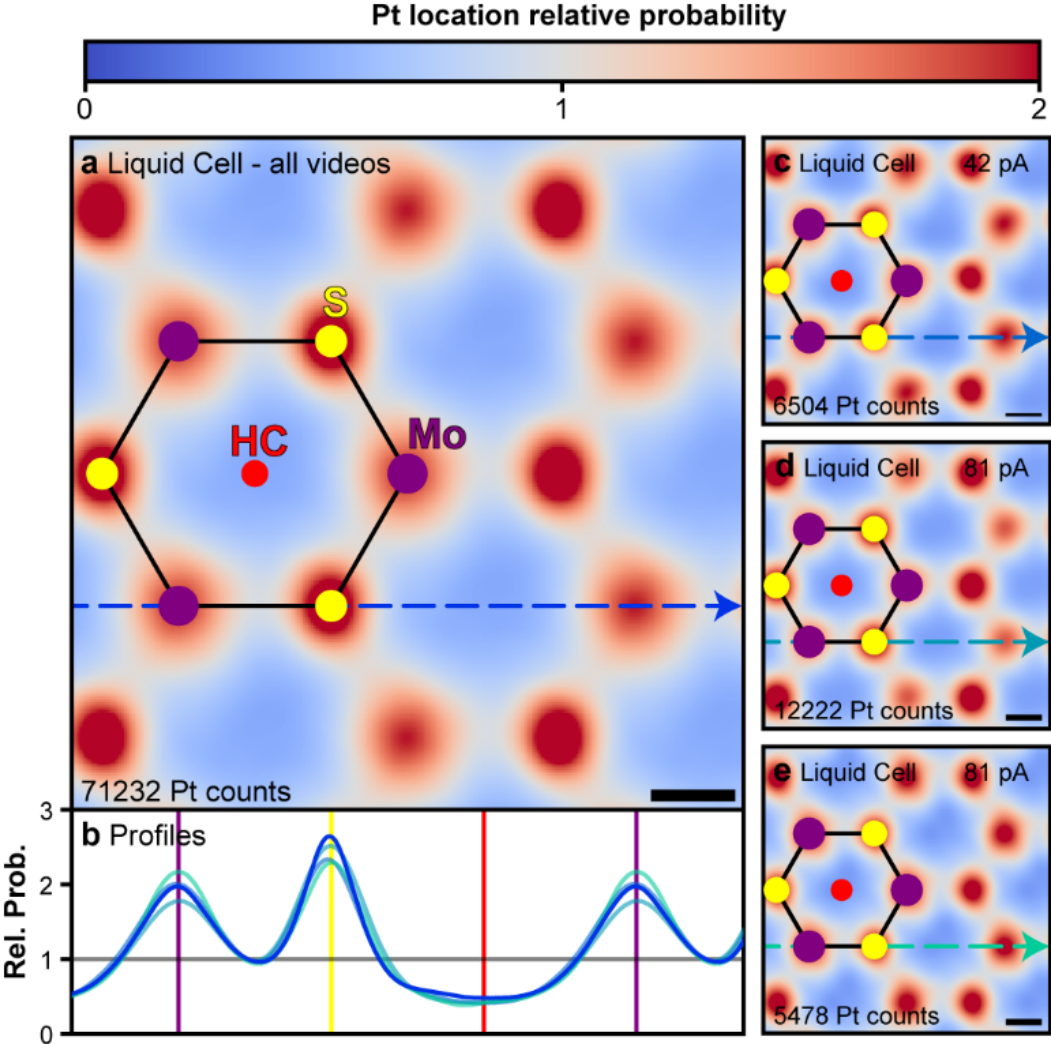
abstract = {Single atoms or ions on surfaces affect processes from nucleation1 to electrochemical reactions2 and heterogeneous catalysis3. Transmission electron microscopy (TEM) is a leading approach for visualizing single atoms on a variety of substrates4,5. It conventionally requires high vacuum conditions, but has been developed for in situ imaging in liquid and gaseous environments6,7 with a combined spatial and temporal resolution that is unmatched by any other method —notwithstanding concerns about electron beam effects on samples. When imaging in liquid using commercial technologies, electron scattering in the windows enclosing the sample and in the liquid generally limits the achievable resolution to a few nanometres6,8,9. Graphene liquid cells, on the other hand, have enabled atomic resolution imaging of metal nanoparticles in liquids10. Here we show that a double graphene liquid cell, comprised of a central molybdenum disulphide monolayer separated by hexagonal boron nitride spacers from the two enclosing graphene windows, makes it possible to monitor with atomic resolution the dynamics of platinum adatoms on the monolayer in an aqueous salt solution. By imaging over 70,000 single adatom adsorption sites, we compare the site preference and dynamic motion of the adatoms in both a fully hydrated and vacuum state. We find a modified adsorption site distribution and higher diffusivities for the adatoms in liquid phase compared to those in vacuum. This approach paves the way for in situ liquid phase imaging of chemical processes with single atom precision.},

keywords = {Two-dimensional Materials, Water at Interfaces},

pubstate = {published},

tppubtype = {article}

}