
2026

Samuel W. Coles, Amir Hajibabaei, Venkat Kapil, Xavier R. Advincula, Christoph Schran, Stephen J. Cox, Angelos Michaelides
Nanoconfined superionic water is a molecular superionic Journal Article
In: Sci. Adv., vol. 12, no. 15, pp. eadz6392, 2026.
Abstract | Links | BibTeX | Tags: Charge Transfer, Confinement, Hydrogen Bonding, Water
@article{Coles2026/10.1126/sciadv.adz6392,

title = {Nanoconfined superionic water is a molecular superionic},

author = {Samuel W. Coles and Amir Hajibabaei and Venkat Kapil and Xavier R. Advincula and Christoph Schran and Stephen J. Cox and Angelos Michaelides},

url = {https://www.science.org/doi/full/10.1126/sciadv.adz6392},

doi = {10.1126/sciadv.adz6392},

year  = {2026},

date = {2026-04-10},

journal = {Sci. Adv.},

volume = {12},

number = {15},

pages = {eadz6392},

abstract = {Superionic ice, where water molecules dissociate into a lattice of oxygen ions and a rapidly diffusing "gas" of protons, represents a state of matter with broad implications for planetary interiors and energy applications. Recently, a nanoconfined superionic state of water has been predicted which, in contrast, is composed of intact water molecules. Here, we apply machine learning and electronic structure simulations to establish how nanoconfined water can be both molecular and superionic, providing more general insights into superionic behavior. Similar to bulk ice and other superionic materials, nanoconfined water conducts via concerted chain-like proton migrations, which cause the rapid propagation of defects. However, unlike other molecular phases of water, its exceptional conductivity arises from the activation of the Grotthuss mechanism by (i) low barriers to proton transfer and (ii) a flexible hydrogen bonded network. We propose that these are two key characteristics of fast ionic conduction in molecular superionics.},

keywords = {Charge Transfer, Confinement, Hydrogen Bonding, Water},

pubstate = {published},

tppubtype = {article}

}

Yixuan Feng, Xavier R. Advincula, Hongwei Fang, Christoph Schran
Clay edges are dynamic proton-conducting networks modulated by structure and pH Journal Article
In: J. Phys. Chem. Lett., vol. 17, iss. 9, pp. 2679–2688, 2026.
Abstract | Links | BibTeX | Tags: Charge Transfer, Chemical Reactivity, Ions in Water, Water, Water at Interfaces
@article{Feng2026/10.1021/acs.jpclett.5c03748,

title = {Clay edges are dynamic proton-conducting networks modulated by structure and pH},

author = {Yixuan Feng and Xavier R. Advincula and Hongwei Fang and Christoph Schran},

url = {https://pubs.acs.org/doi/full/10.1021/acs.jpclett.5c03748},

doi = {10.1021/acs.jpclett.5c03748},

year  = {2026},

date = {2026-02-22},

urldate = {2026-02-22},

journal = {J. Phys. Chem. Lett.},

volume = {17},

issue = {9},

pages = {2679–2688},

abstract = {Montmorillonite, a ubiquitous clay mineral, plays a vital role in geochemical and environmental processes due to its chemically complex edge surfaces. However, the molecular-scale acid-base reactivity of these interfaces remains poorly understood due to the limitations of both experimental resolution and conventional simulations. Here, we employ machine learning potentials with first-principles accuracy to perform nanosecond-scale molecular dynamics simulations of montmorillonite nanoparticles across a range of pH. Our results reveal clear amphoteric behavior, with edge sites undergoing protonation in acidic environments and deprotonation in basic conditions, accompanied by pH-dependent surface charge regulation. Even at neutral pH, spontaneous and directional proton transfer events are common, proceeding via both direct and solvent-mediated pathways. These findings demonstrate that montmorillonite edges are not static arrays of hydroxyl groups but dynamic, proton-conducting networks whose reactivity and charge state are modulated by local structure and solution conditions. This work offers a molecular-level framework for understanding proton transport and buffering in clay-water systems, with broad implications for catalysis, ion exchange, and environmental remediation.},

keywords = {Charge Transfer, Chemical Reactivity, Ions in Water, Water, Water at Interfaces},

pubstate = {published},

tppubtype = {article}

}
2025

Yongkang Wang, Haojian Luo, Xavier R. Advincula, Zhengpu Zhao, Ali Esfandiar, Da Wu, Kara D. Fong, Lei Gao, Arsh S. Hazrah, Takashi Taniguchi, Christoph Schran, Yuki Nagata, Lydéric Bocquet, Marie-Laure Bocquet, Ying Jiang, Angelos Michaelides, Mischa Bonn
Spontaneous surface charging and Janus nature of the hexagonal boron nitride–water interface Journal Article
In: J. Am. Chem. Soc., vol. 147, iss. 33, pp. 30107–30116, 2025.
Abstract | Links | BibTeX | Tags: Charge Transfer, Machine Learning Potentials, Water at Interfaces
@article{Wang2025/10.1021/jacs.5c07827,

title = {Spontaneous surface charging and Janus nature of the hexagonal boron nitride–water interface},

author = {Yongkang Wang and Haojian Luo and Xavier R. Advincula and Zhengpu Zhao and Ali Esfandiar and Da Wu and Kara D. Fong and Lei Gao and Arsh S. Hazrah and Takashi Taniguchi and Christoph Schran and Yuki Nagata and Lydéric Bocquet and Marie-Laure Bocquet and Ying Jiang and Angelos Michaelides and Mischa Bonn},

url = {https://pubs.acs.org/doi/full/10.1021/jacs.5c07827},

doi = {10.1021/jacs.5c07827},

year  = {2025},

date = {2025-08-06},

urldate = {2025-08-06},

journal = {J. Am. Chem. Soc.},

volume = {147},

issue = {33},

pages = {30107–30116},

abstract = {Boron, nitrogen, and carbon are neighbors in the periodic table and can form strikingly similar twin structures─hexagonal boron nitride (hBN) and graphene─yet nanofluidic experiments demonstrate drastically different water friction on them. We investigate this discrepancy by probing the interfacial water and atomic-scale properties of hBN using surface-specific vibrational spectroscopy, atomic-resolution atomic force microscopy (AFM), and machine learning-based molecular dynamics. Spectroscopy reveals that pristine hBN acquires significant negative charges upon contacting water at neutral pH, unlike hydrophobic graphene, leading to interfacial water alignment and stronger hydrogen bonding. AFM supports that this charging is not defect-induced. pH-dependent measurements suggest $OH^–$ chemisorption and physisorption, which simulations validate as two nearly equally stable states undergoing dynamic exchange. These findings challenge the notion of hBN as chemically inert and hydrophobic, revealing its spontaneous surface charging and Janus nature, and providing molecular insights into its higher water friction compared to carbon surfaces.},

keywords = {Charge Transfer, Machine Learning Potentials, Water at Interfaces},

pubstate = {published},

tppubtype = {article}

}
2017
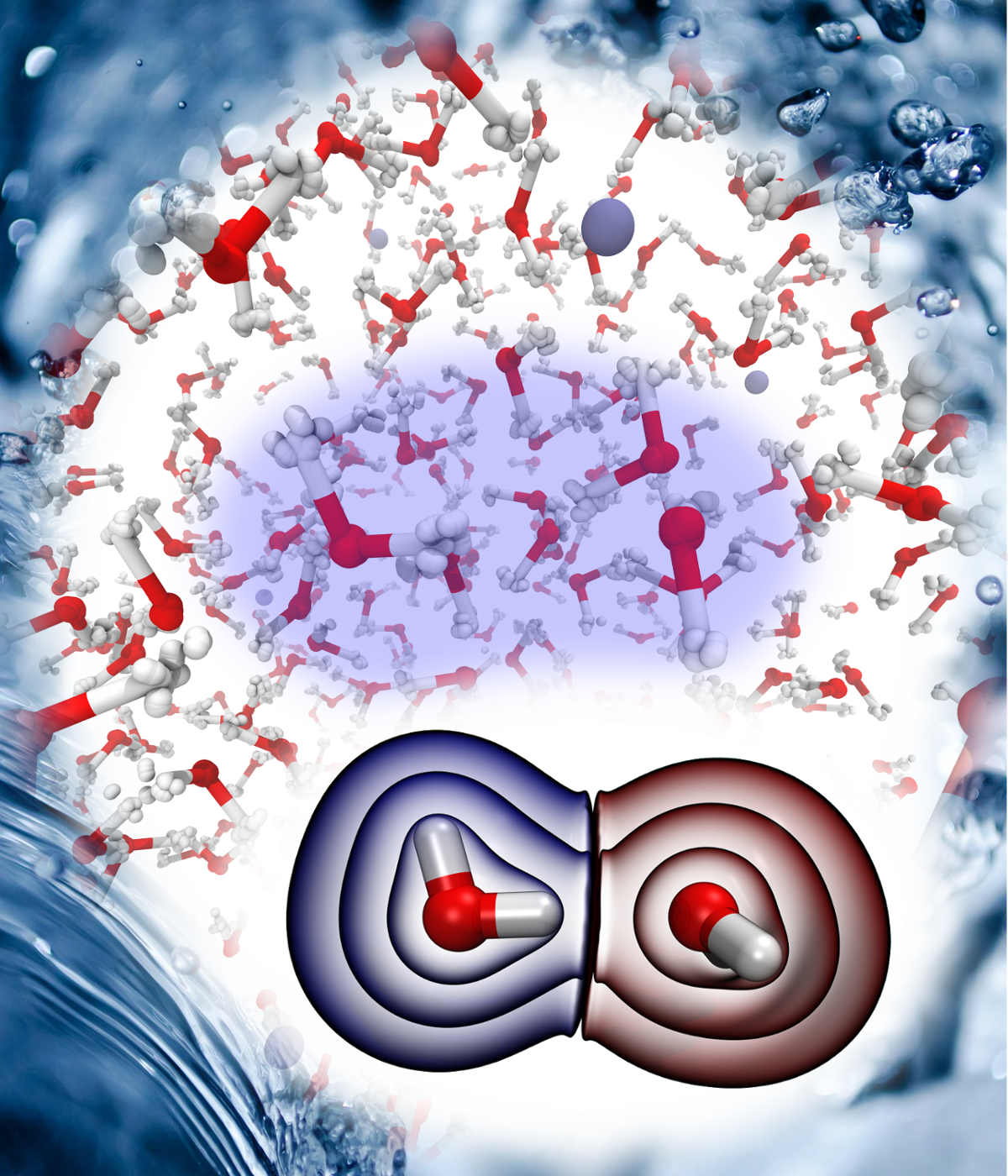
Christoph Schran, Ondrej Marsalek, Thomas E. Markland
Unravelling the influence of quantum proton delocalization on electronic charge transfer through the hydrogen bond Journal Article
In: Chem. Phys. Lett., vol. 678, pp. 289–295, 2017, ISSN: 00092614.
Abstract | Links | BibTeX | Tags: Charge Transfer, Hydrogen Bonding, Ions in Water, Nuclear Quantum Effects (NQEs), Water
@article{Schran2017/10.1016/j.cplett.2017.04.034,

title = {Unravelling the influence of quantum proton delocalization on electronic charge transfer through the hydrogen bond},

author = {Christoph Schran and Ondrej Marsalek and Thomas E. Markland},

doi = {10.1016/j.cplett.2017.04.034},

issn = {00092614},

year  = {2017},

date = {2017-06-01},

urldate = {2017-06-01},

journal = {Chem. Phys. Lett.},

volume = {678},

pages = {289–295},

abstract = {Upon hydrogen bond formation, electronic charge density is transferred between the donor and acceptor, impacting processes ranging from hydration to spectroscopy. Here we use ab initio path integral simulations to elucidate the role of nuclear quantum effects in determining the charge transfer in a range of hydrogen bonded species in the gas and liquid phase. We show that the quantization of the nuclei gives rise to large changes in the magnitude of the charge transfer as well as its temperature dependence. We then explain how a single geometric parameter determines the charge transfer through the hydrogen bond. These results thus demonstrate that nuclear quantum effects are vital for the accurate description of charge transfer and offer a physically transparent way to understand how hydrogen bonding gives rise to it.},

keywords = {Charge Transfer, Hydrogen Bonding, Ions in Water, Nuclear Quantum Effects (NQEs), Water},

pubstate = {published},

tppubtype = {article}

}